Summary
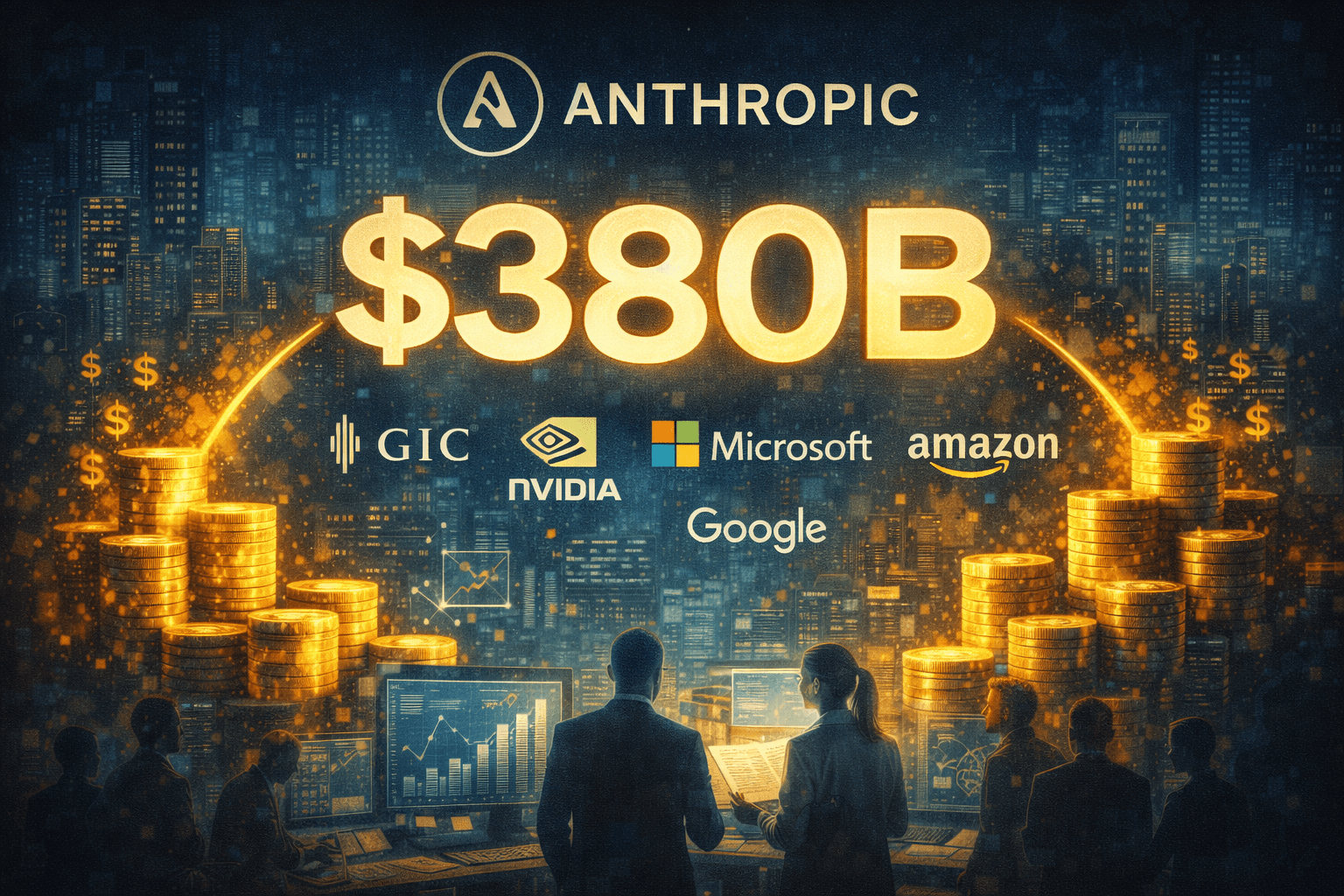
Anthropic has surged to a reported $380 billion valuation after raising $30 billion in a funding round led by Singapore sovereign wealth fund GIC and U.S. investor Coatue, with participation from heavyweight backers including Nvidia, Microsoft, Amazon, and Google, according to AP News. The number is not just eye watering, it is a message to the entire AI market that the center of gravity may be shifting faster than anyone wants to admit.
This is the kind of financing that stops being about runway and starts being about rewriting the competitive map. It raises an uncomfortable question, whether today AI leaders are being valued for what they have built, or for the fear of being left behind.
A valuation that behaves like a weapon
$380 billion is not a price tag, it is leverage. At that scale, a company can buy time, talent, compute priority, and political attention, while also making every potential partner slightly more dependent and every rival slightly more nervous. The round reads less like venture optimism and more like strategic stockpiling, a response to the belief that the next model cycle could redraw entire industries.
There is a darker logic here. In AI, capital is not merely fuel, it is a gating mechanism. The best models increasingly require scarce chips, premium data pipelines, and research teams that have to be recruited away from competitors who already pay like professional sports franchises. A mega round turns those constraints into advantages, and it nudges the rest of the field toward consolidation, even if everyone insists they want a vibrant ecosystem.
When rivals become investors
The investor list is the part that should make readers squint. Nvidia, Microsoft, Amazon, and Google showing up around the same table signals that competition is no longer cleanly separated from hedging. Big tech firms are not just picking winners, they are buying optionality, a portfolio approach to a future where model quality and platform control might decouple.
That creates a strange cultural mood in the industry, a mix of ideological talk about safety and openness, paired with ruthless tactics around distribution, compute access, and default placement inside products. If everyone invests in everyone, accountability gets foggy. Who pressures whom on governance when the cap table looks like a mutual assurance pact?
The OpenAI question, and the mirror it holds up
Anthropic’s leap intensifies the obvious rivalry with OpenAI, but the more interesting story is what it reveals about the market’s psychology. Valuations at this altitude imply that investors expect not just great products, but durable dominance, and that expectation can become self fulfilling. Talent follows perceived inevitability. Partners follow momentum. Regulators follow headlines.
Yet the same forces can calcify innovation into a two or three player contest where model progress becomes a closed loop, fed by capital, compute, and distribution, rather than by surprising ideas. If Anthropic is worth $380 billion now, the industry is implicitly saying that the real scarcity is not intelligence, it is control over the infrastructure that makes intelligence look inevitable. The next year will test whether this is confidence, or a very expensive form of panic.